Small drayage carriers
Owner-run fleets of a few trucks leaving spreadsheets behind.

Owner-operators
Whether you own the truck and haul under a carrier’s authority, or you run a one-truck company, here is what Dispatch Board does for owner-operators and for the carriers who pay them.
Most owner-operators meet Dispatch Board in one of two ways. In the first, you haul for a carrier that uses it, and you get a driver login. In the second, you run your own small company and use it as your office. This page covers both, and says plainly where the price may not suit a single truck.
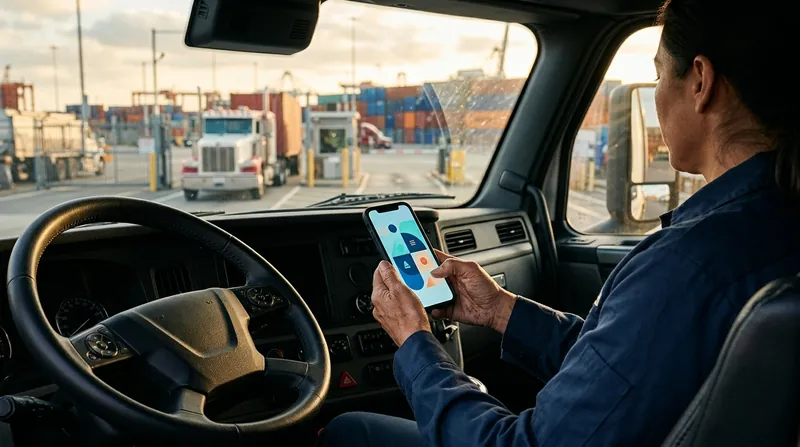
Your login opens the driver app, a web app you add to your phone’s home screen. Each move shows its stops, documents and a to-do list before you leave. You can accept or decline a move with a reason, or send “on my way”, if the carrier switches those on. Photos, signed PODs and PDFs are saved on your phone and uploaded when signal returns, so a dead spot in a terminal does not lose your proof of delivery.
Your location goes to the live map, so dispatch can see where you are without calling. That is something to ask a carrier about before you sign on, as with any GPS tracking.

Settlements show what you earned, the deductions taken and any deduction carried forward to the next period. Deductions that cannot be recovered in one period roll over rather than disappearing, and each settlement can be opened as a PDF statement in the app. Carriers can set up owner-operator settlements separately from employee driver pay, with factoring entries, advances and reserves recorded where they apply. The detail depends on how your carrier sets it up, so ask them what they enable.
Waiting time is where owner-operators lose the most money without noticing. The waiting-time audit uses GPS pings inside the terminal geofence, and wait documents can be attached to the load. When a carrier disputes or bills detention, the evidence comes from timestamps rather than memory.
Per diem is a related worry, because the bill lands on the carrier and arguments about whose fault it was fall on the driver. Dispatch Board records a reason for each charged day, such as a terminal closure, a hold, a container that was not available, a later appointment or a late customer delivery. If the day was not your fault, the record shows that.
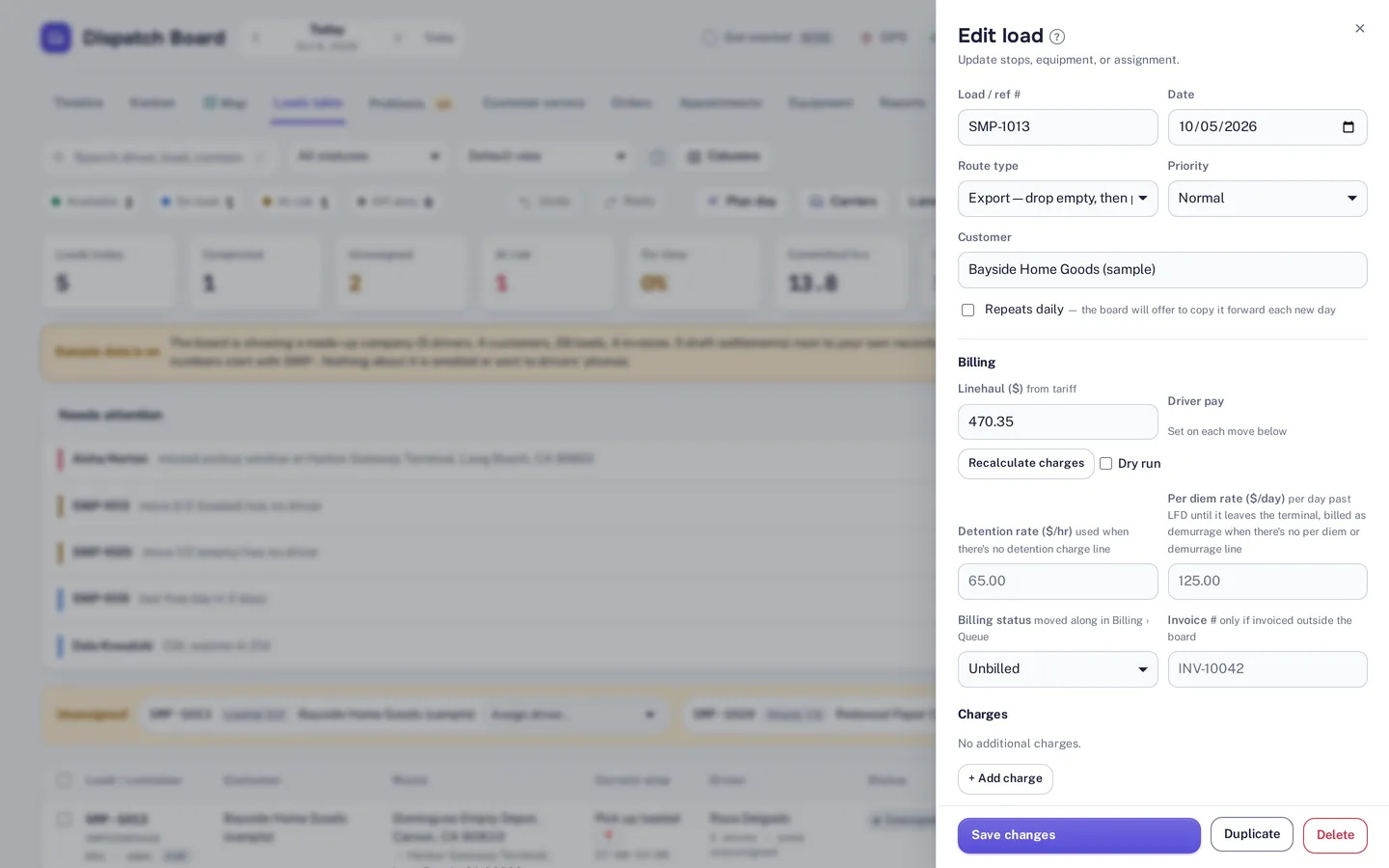
You can run your own account: load and customer records, a dispatch board, invoices to your own customers and QuickBooks Online or Xero sync. Lite costs $149 a month in Canadian dollars and includes 5 trucks, so a single truck pays the whole base price. That is a lot for one truck. If your main need is invoicing and keeping paperwork straight, a simpler tool may be cheaper, and a trial will tell you whether the dispatch and recovery features earn their keep.
If you are building toward a small fleet, Lite is built for that step: unlimited dispatcher logins, the driver app and GPS, and customer invoices, with extra trucks at $15 each up to 15. Plans are month to month and the first 14 days are free with no card.
For a carrier, owner-operators are a settlement type, not a separate system. Pay, deductions and statements are produced the same way as for employees, and the BC port compliance add-on ($79 a month) runs a pay check each period against the Container Trucking Act rate order for BC port work. It starts from the published 1 July 2026 figures, so confirm them against the current order. Read our small carrier page for the rest of the carrier side.
Dispatch Board does not book terminal appointments for you automatically, has no EDI and does not sync with QuickBooks Desktop. The driver app is a web app, not an app-store download. Settlements and the customer portal are on the Medium plan and above.
Self sign-up gives you a company with sample data and a get-started checklist, so you can look around before you enter anything of your own. Then bring in your real freight: import drivers, trucks, chassis, customers, rate tables and loads from Excel, CSV or a PDF rate sheet. The importer matches columns by heading, checks every row before saving and flags duplicates.
Add your terminals and their gate hours, invite your drivers to the driver app, and run a real week alongside your current system. The Help Center has a guide for every screen. A bar at the top of the board shows the days left in the 14-day trial, and the account owner gets an email two days before it ends. Plans are month to month, and you can download a backup file and a CSV of your loads at any time.
Questions
Driver logins are free. The carrier pays for the trucks on its plan, and you use the driver app under that account.
Yes, if your carrier uses settlements. The driver app shows settlements, deductions and PDF statements.
It depends on your volume and how much you lose to per diem, chassis and waiting time. Use the free 14-day trial to find out. If you only need invoicing, a simpler tool may suit you better.
The driver app sends your location to the live map, and the waiting-time audit uses GPS pings in the terminal geofence. Ask your carrier how they use it before you accept the work.
Photos, signed PODs and PDFs are saved on the phone and uploaded when signal returns.
Owner-run fleets of a few trucks leaving spreadsheets behind.
A web app drivers add to the home screen.
Pay for drivers, owner-operators and carriers.
Every company gets 14 days free with no card. Import a week of your own freight and judge it yourself.