Guide
Demurrage vs detention vs per diem: who bills what.
Three words for charges that sound alike but have different clocks and different billers. A worked example of one import container.

Guides / Pricing
Base rates, fuel surcharge, accessorials and terms in a layout you can copy into a spreadsheet, with a worked quote.
Container drayage rate sheets differ fundamentally from standard freight quotes. While dry van quotes focus on highway mileage, drayage operates across congested terminals, rail ramps, chassis depots, and customer docks. Without accounting for these friction points, fleets absorb facility delays, equipment shortages, and driver detention from operating margins.
A structured rate sheet separates line-haul transport from equipment costs, dock waiting times, and accessorial services, establishing transparent billing for cargo owners, forwarders, and customs brokers.
Organize pricing into four components:
Set up your base spreadsheet with eight columns:
Keep fuel tables, accessorial tariffs, and commercial terms on separate worksheets so you can update weekly indices without rebuilding base rates.
The base line-haul rate covers tractor power, driver labor, maintenance, and fuel between an intermodal terminal and customer dock. Rates are usually quoted for the whole move, including returning the empty or delivering the loaded export to the terminal.
Carriers typically choose between three pricing models:
Equipment size also dictates pricing. Standard forty-foot dry containers serve as the baseline. Twenty-foot containers may carry matching rates or modest discounts, though heavy units require specialized tri-axle chassis. Fifty-three-foot domestic containers and forty-five-foot ocean units require extended equipment and wider turning room, warranting dedicated rate lines.
Diesel prices fluctuate constantly. Absorbing spikes into fixed rates erodes margins, while monthly renegotiations disrupt customer trust. Drayage fleets solve this with an indexed fuel surcharge schedule adjusting automatically against an objective public benchmark.
In Canada, carriers peg surcharges to weekly retail diesel prices from Natural Resources Canada. In the United States, fleets reference weekly highway diesel data from the U.S. Energy Information Administration. State explicitly which index, geographic region, and weekday reset schedule apply.
A standard schedule establishes a baseline peg below which no surcharge applies, followed by progressive step intervals. Zone drayage uses a percentage of base line-haul, while regional runs use a per-kilometre or per-mile surcharge.
The following list is an illustrative, made-up example using round numbers to show tier structure; it does not reflect current fuel prices or recommended rates:
Specify that fuel surcharges apply exclusively to base line-haul, never to accessorial fees.
Accessorials cover ancillary services, equipment expenses, and operational delays outside an uninterrupted move. In intermodal drayage, terminal bottlenecks, chassis shortages, customs holds, and warehouse delays absorb fleet capacity daily. If an accessorial is omitted from your tariff, customers assume it is included in your base rate.
Every accessorial entry must define the service, billing increment, trigger condition, and documentation requirements:
Commercial terms and conditions establish clear operational boundaries, preventing billing disputes and overdue receivables.
Establish a minimum trip charge for all dispatches. For short shunts or local moves, standard formulas can fall below basic operating costs. A minimum charge guarantees every dispatch covers driver wages, insurance, fuel, and terminal turn time.
State credit terms, payment deadlines, and late penalties clearly. Specify whether invoices are due upon receipt with signed delivery receipts or under agreed net terms. Detail interest charged on past-due balances.
Include explicit validity dates on every rate sheet. Spot quotes carry short validity windows, whereas contractual tariffs remain active for six months or a year. Include a review clause for labor disruptions, fuel spikes, or regulatory fee adjustments.
State clearly whether rates are quoted in Canadian Dollars (CAD) or United States Dollars (USD). Never mix currencies on a single tariff.
In Canada, sales taxes apply based on destination and movement classification:
The following calculation is an illustrative, made-up example using invented round numbers to demonstrate how base rates, fuel surcharges, accessorials, and taxes combine on a drayage invoice. These numbers do not reflect current market rates.
Imagine an import container moving from a marine terminal to an industrial receiver in an adjacent commercial zone:
In your spreadsheet, organize workbooks into functional tabs: Tab 1 for base rates, Tab 2 for accessorial tariffs, and Tab 3 for fuel scales. Use data validation dropdowns for zones, container sizes, and accessorial codes to prevent clerical errors and ensure clean exports into dispatch systems.

Many carriers update fuel surcharges weekly, after the index is published. In Canada, Natural Resources Canada updates retail diesel prices weekly; in the United States, the U.S. Energy Information Administration does the same. A regular schedule ensures transparency and protects margins from sudden price jumps.
Demurrage is a penalty charged by a terminal or rail ramp when a container exceeds allowed free time on facility property. Yard storage is an accessorial fee charged by the carrier for holding a container in its secure compound. Pre-pulling containers avoids steep terminal penalties by moving boxes into carrier storage.
A domestic drayage move may be zero-rated (0% tax) if it forms an unbroken leg of continuous international transport originating outside Canada or destined for export. Carriers must retain proof of continuous carriage, such as through bills of lading or customs manifests. Check current requirements with the Canada Revenue Agency.
Many carriers calculate detention from the later of the appointment time and the actual arrival, so a driver who arrives early is not billed for the early wait. Write your rule into your terms. Automated GPS geofence logs and signed delivery receipts make detention charges verifiable and defensible.
Daily chassis rental covers equipment use and maintenance for the calendar day. A chassis split fee compensates the carrier for additional tractor transit, fuel, and gate queues when picking up or terminating a chassis at a separate depot. Because it requires a separate trip, it is billed as an independent expense.
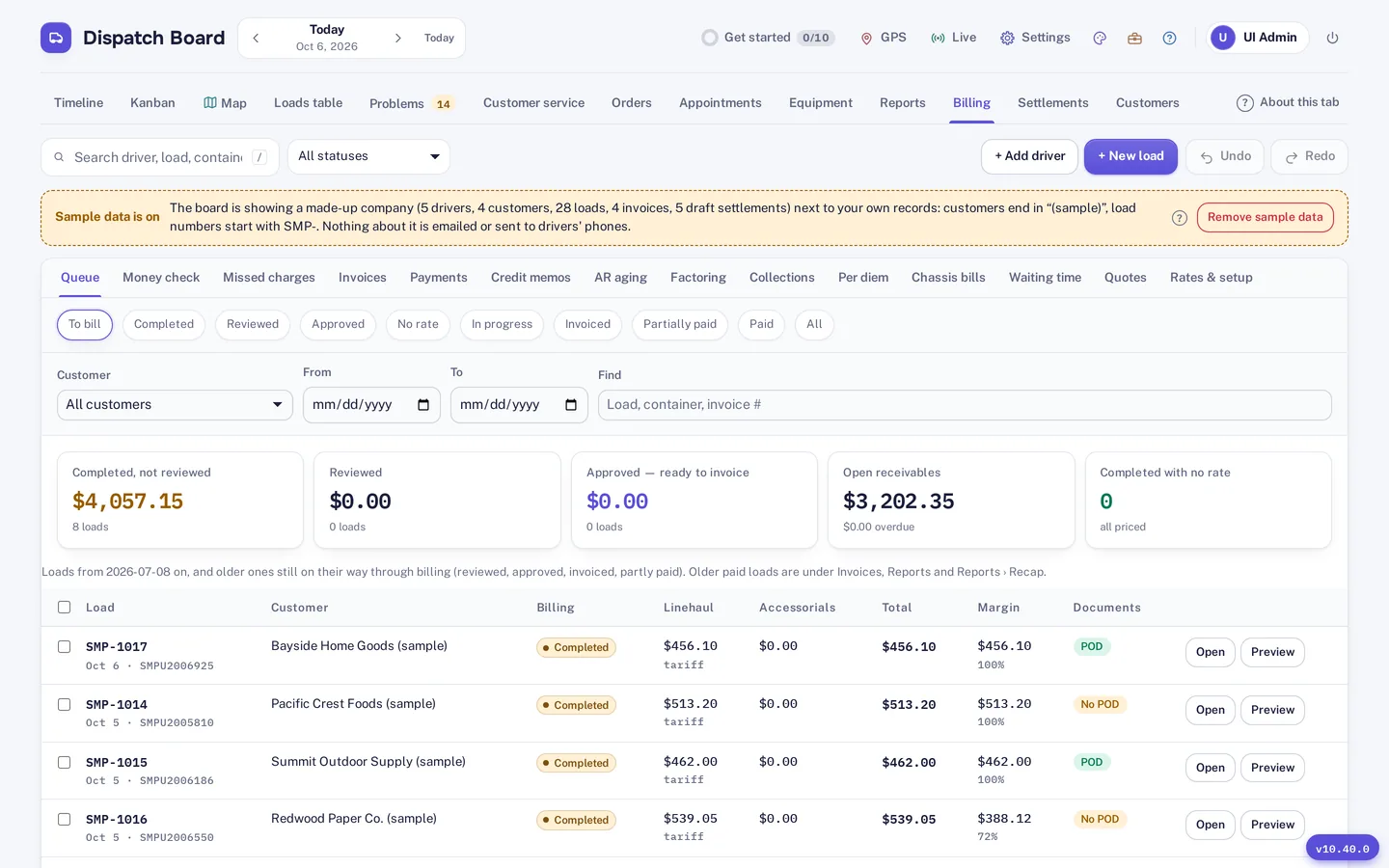
Dispatch Board can import your rate sheet from Excel, CSV or a PDF, then apply it: rate profiles, tariffs, accessorial rules and a fuel surcharge table all feed a billing queue of loads ready to invoice, with credit memos and aging. Prices can be in Canadian or US dollars, with GST, HST, QST and PST handled on invoices, and distance in kilometres or miles.
Waiting time that supports an accessorial comes from the waiting-time audit, which uses GPS pings in the geofence and wait documents, and a missed-charge finder flags loads that left out something billable. Try it free for 14 days with your own rates.
This guide is general information from the Dispatch Board team, not legal, tax or accounting advice. Rules and rates change: confirm against the official source linked in the text before you rely on them.
Keep reading
Guide
Three words for charges that sound alike but have different clocks and different billers. A worked example of one import container.
Guide
Who needs a CTS licence, how the rate order is structured and a period-by-period pay check, with links to the official OBCCTC pages.
Guide
Eight steps from business number to first invoice, with pointers to where each current rule is published and the mistakes new carriers repeat.
Product
Product
Start a 14-day trial and import your rates from Excel, CSV or a PDF.