Guide
What is per diem in drayage?
The daily equipment charge that quietly eats margin: how it starts, how days are counted, who pays and how to rebill or dispute it.

Guides / Chassis
Chassis bills often charge days you did not use. A line-by-line audit, a worked example and what to put in the dispute.
Chassis pool billing can quickly erode operating margins if invoices go unchecked. Across North American intermodal transport, equipment providers such as DCLI, TRAC Intermodal, Flexi-Van, and regional cooperative pools supply the chassis that move ocean and domestic containers. Whether your fleet operates out of marine terminals, rail ramps, or off-dock depots, billing runs on a standard mechanism: daily rental fees tied directly to gate interchange events.
The billing cycle begins when a driver out-gates a chassis. The facility records the move and issues an Equipment Interchange Receipt (EIR) or gate slip capturing the equipment number, carrier Standard Carrier Alpha Code (SCAC), date, and timestamp. That out-gate event signals to the pool provider that your company has assumed custody and financial responsibility.
Billing accrues daily until the chassis is formally in-gated back into an approved facility. While straightforward in concept, pools process millions of transactions monthly across hundreds of facilities using optical cameras, barcode scanners, and manual entries. When that tracking chain fails, billing engines default to charging the motor carrier. Daily rates and billing rules vary across providers and pools, so carriers should check the current rule in their equipment contract and pool tariff schedule.
Chassis statements can arrive weeks after return. Without systematic verification against gate slips, GPS logs, and dispatch manifests, carriers pay for equipment usage they never incurred.
Chassis statements frequently contain clerical and systemic errors. Automated billing engines rely on terminal gate feeds where missed scans or keypunch mistakes create invalid line items:
Challenging incorrect charges requires verifiable operating records. Equipment pools handle heavy dispute volumes and reject unsubstantiated claims. A structured audit workflow ensures every disputed line item is supported by concrete documentation.
The cornerstone of invoice auditing is the Equipment Interchange Receipt. Every time a driver enters or leaves a facility, an electronic or paper EIR is generated. Paper slips left in cabs are easily lost, so drivers should capture clear digital photos at the gate using a mobile web app. Drivers should also photograph chassis and container numbers to provide visual proof if a pool claims equipment was returned to the wrong yard.
Your audit checklist should cross-reference each invoice line against five core operational fields:
If any field fails to match your operating records, flag the line item for dispute immediately. Always check the dispute window defined in your pool agreement, as late claims are routinely denied.
The following scenario is a completely made-up illustration using invented, round numbers to show how a carrier calculates overcharges, gathers proof, and structures a financial dispute.
An independent carrier receives a weekly statement from a hypothetical chassis pool provider covering five equipment units. The contract establishes an illustrative daily usage fee of $30.00 CAD per calendar day.
During the audit, dispatch identifies irregular charges on chassis unit ABCZ-100200 and an unfamiliar unit. According to the pool invoice:
The dispatcher audits these charges against operating logs:
Summary of the dispute calculation:
Supported by gate receipts and GPS breadcrumbs, the carrier submits a formal dispute claim requesting a credit of $360.00 CAD.

Submitting an effective dispute requires an organized, self-contained packet. Pool billing departments handle vast transaction volumes, and claims submitted without clear documentation face rejection or lengthy delays.
Begin with a concise cover letter or summary containing your basic business details:
Attach primary source records for each disputed unit in chronological order:
Many providers take disputes through a web portal or a template with reason codes such as incorrect termination date, duplicate billing or invalid interchange. Ask your provider how it wants them submitted.
Maintain permanent records of every submission, including copies of dispute letters, original invoices, documentation packets, and pool confirmations. Track claims systematically to ensure credit memos appear on future statements.
Dispute windows vary by pool provider and contract terms. Some agreements require dispute submissions within a few weeks of the invoice date, while others allow a longer timeframe under standard rules. Missing this deadline forfeits your right to contest the charge, so check the current rule in your pool agreement or tariff schedule and audit incoming statements promptly.
If a gate kiosk or clerk fails to print a slip, the driver should photograph the gate exit screen showing transaction approval. Dispatch should log the gate time and preserve tractor GPS breadcrumbs showing entry, dwell time, and bobtail departure. These location records and dispatch manifests provide credible secondary evidence if the pool fails to record the return.
Yes, daily rental fees apply to the chassis asset itself, whether mounted or bare. Billing errors occur frequently on bare returns because off-dock depots often experience delays entering bare equipment into inventory systems. Drivers must always obtain an explicit bare-chassis in-gate receipt to prove the unit has officially cleared company custody.
Duplicate line items usually happen when billing engines process two electronic records for the same movement. This occurs when a gate event is manually edited after an automated scan or when ocean carrier data conflicts with direct pool feeds. When an audit reveals overlapping dates, dispute the redundant line item using the master interchange receipt.
Under merchant haulage, the motor carrier or cargo owner is responsible for securing and paying for the chassis directly with the pool. In carrier haulage moves, the ocean carrier may provide or absorb the chassis under their bill of lading, but terms vary by line and facility. Review the booking confirmation and pool agreement to confirm whether charges belong to the shipping line or the trucker.
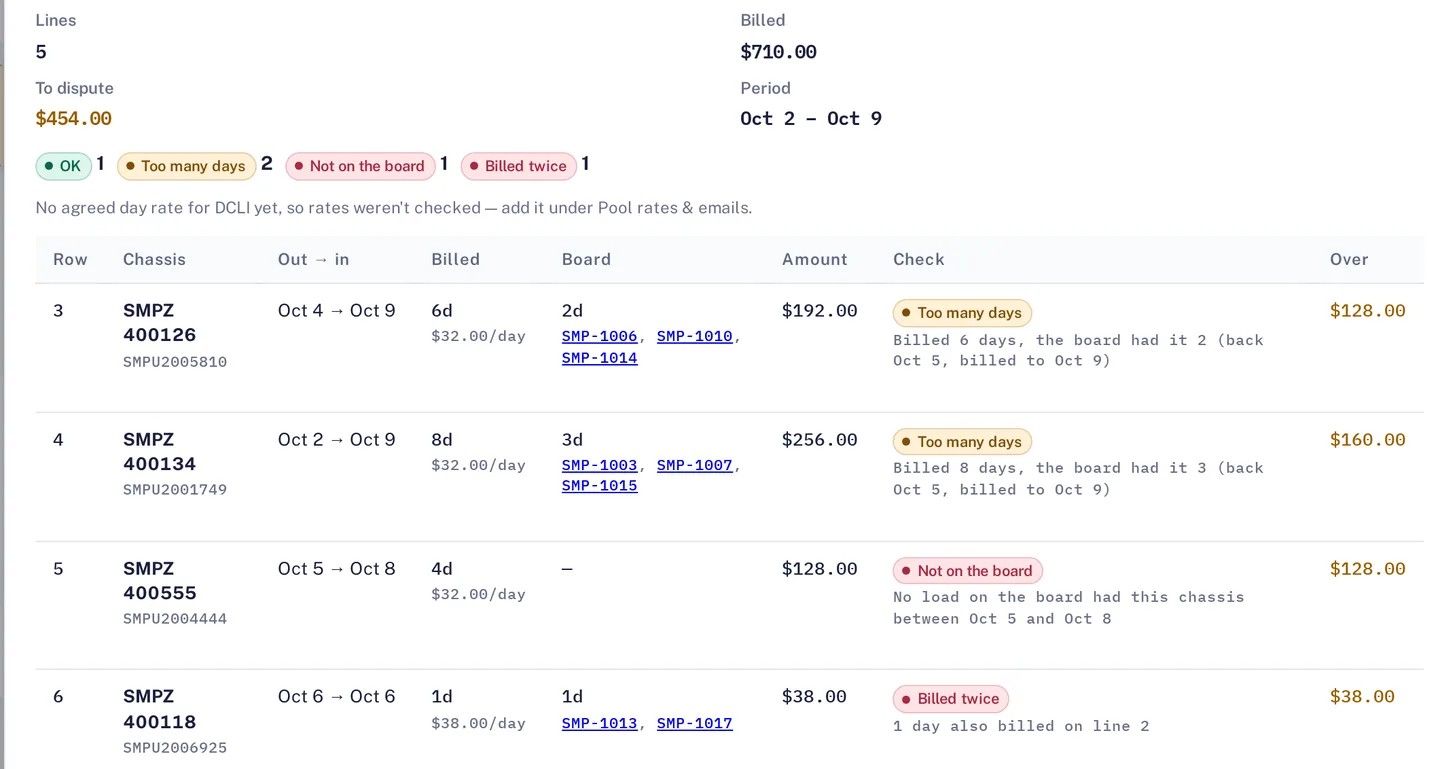
Dispatch Board's chassis bill checker takes DCLI, TRAC and Flexi-Van invoices and checks each line against when your loads actually had the chassis, then produces a dispute letter and a CSV. The driver app puts photos, signed PODs and documents on the load, even when a terminal has no signal, and the waiting-time audit keeps GPS pings in the geofence as evidence.
That means the records you need for a dispute are already attached to the load when the invoice arrives. Try it free for 14 days with your own invoice.
This guide is general information from the Dispatch Board team, not legal, tax or accounting advice. Rules and rates change: confirm against the official source linked in the text before you rely on them.
Keep reading
Guide
The daily equipment charge that quietly eats margin: how it starts, how days are counted, who pays and how to rebill or dispute it.
Guide
Three words for charges that sound alike but have different clocks and different billers. A worked example of one import container.
Guide
Two ways to stop driving empty: what each needs, why lines say no and a worked mileage example with made-up numbers.
Product
Product
Start a 14-day trial and run your next DCLI, TRAC or Flexi-Van invoice through the checker.