Guide
Demurrage vs detention vs per diem: who bills what.
Three words for charges that sound alike but have different clocks and different billers. A worked example of one import container.

Guides / Per diem
The daily equipment charge that quietly eats margin: how it starts, how days are counted, who pays and how to rebill or dispute it.
Container drayage connects marine ports and rail ramps to customer warehouses, transloads, and distribution centers. Shipping containers moving over public roads are capital assets owned or leased by ocean shipping lines rather than trucking carriers or cargo receivers.
Per diem is the daily equipment charge billed by an ocean carrier when a container remains in a motor carrier's custody outside a terminal past allowed free time. When an import container arrives, the line grants a designated window of free days to retrieve the box, unload cargo, and return the empty container to an authorized facility.
Once free time expires, the carrier bills a daily fee for every additional day the equipment remains out to maintain container velocity. For drayage motor carriers, per diem is a real financial risk. Understanding how per diem functions, how days are counted, and how to allocate responsibility protects fleet profitability.
In intermodal transportation, per diem, demurrage, driver detention, and carrier storage refer to distinct costs assessed by different commercial entities.
Distinguishing these charges ensures dispatchers bill the correct party and avoid absorbing third-party expenses.
Determining who is legally responsible for per diem versus who receives the invoice creates friction in container drayage. Maritime practices split legal liability on paper from financial collection in practice.
Under ocean bills of lading and line tariffs, legal liability for per diem rests with the merchant, including the cargo owner, shipper, and consignee. The cargo owner contracts with the ocean carrier and agrees to tariff terms regarding equipment return deadlines.
In daily operations, however, ocean lines rarely invoice cargo owners directly. Instead, the line bills the drayage motor carrier who pulled the box under an equipment interchange contract. This gives the shipping line leverage, because an unpaid invoice can put your account on hold. Read your interchange agreement to see what the line can do.
Because an unpaid bill can disrupt operations, resolve every bill promptly. When customers delay unloading, the carrier settles the ocean bill and passes the charge through with delivery proof. When delays stem from terminal closures or depot shut-outs, the carrier files a formal dispute to cancel the invoice.
Calculating equipment free time and per diem exposure requires checking the specific ocean carrier tariff, as rules vary across lines.
Equipment free time begins according to terms in the carrier service contract or published tariff. On import moves, the tariff defines when the clock starts, often when the container is out-gated. Equipment free time is separate from terminal storage free time, and the two clocks run under different tariffs. Check the current ocean tariff or service contract to confirm exact free days and start times.
Weekend and holiday rules vary by carrier and region. Some lines pause the clock on non-working days, while others count continuous calendar days once the box leaves the gate. Once free time expires, many tariffs count every calendar day, including weekends and closures. Check the current rule in the specific ocean line tariff.
High-volume shippers often negotiate extended free time in service contracts, whereas smaller shippers receive standard tariff terms. Many tariffs also use progressive tiers that raise the daily rate the longer equipment stays out. Check the current tariff schedule for the specific shipping line to verify applicable rate tiers.
The following figures are an invented, illustrative calculation using round numbers to show how billing flows work. Daily rates, free time allowances, and tier escalations vary widely by ocean carrier, trade lane, and agreement. Always check the current rule in the specific shipping line tariff.
In this scenario, a carrier retrieves an import 40-foot container on Monday morning with 4 calendar days of equipment free time starting on interchange day.
Carrier billing calculation:
Evidence-based cost allocation:
Logging daily operational reasons cleanly separates customer pass-through billing from carrier disputes, protecting operating margins.
Shippers often assume per diem stems from trucking delays, but structural port and rail bottlenecks regularly prevent timely returns despite diligent carrier efforts.

Managing per diem requires disciplined operational workflows to track equipment deadlines, document delays, and defend against unjustified ocean carrier invoices.
Under ocean bills of lading and tariffs, the merchant is legally liable for per diem. In practice, shipping lines invoice the drayage carrier under equipment interchange contracts. The trucker must settle the invoice with the line, then rebill the customer or file a dispute.
Weekend and holiday treatment depends on the specific ocean line tariff and facility location. Some carriers pause the clock on non-working days, while others count continuous calendar days once free time expires. Check the current rule in the specific ocean line tariff.
Per diem is billed by the ocean line for keeping the container box past free time. Chassis fees are separate equipment rentals charged by chassis providers or regional pools for the road chassis. Check the current chassis agreement for daily rates.
Yes, carriers dispute per diem when terminal closures, severe weather, or depot shut-out prevent empty returns. Shipping lines may waive charges when presented with timestamped appointment screenshots and gate shut-out notices. Check line dispute guidelines for filing requirements.
Notify the customer in writing before free time expires that per diem charges will accrue. Once the move is completed, rebill the customer using signed delivery receipts, interchange slips, and agreed accessorial rates. Check your customer contract for agreed billing terms.
Dispatch Board tracks the dates that decide per diem. Container tracking through Terminal49 shows availability and last free day, vessel arrival alerts warn you before a ship lands, and the board shows empty return restrictions so a driver is not sent to a depot that will not take the box.
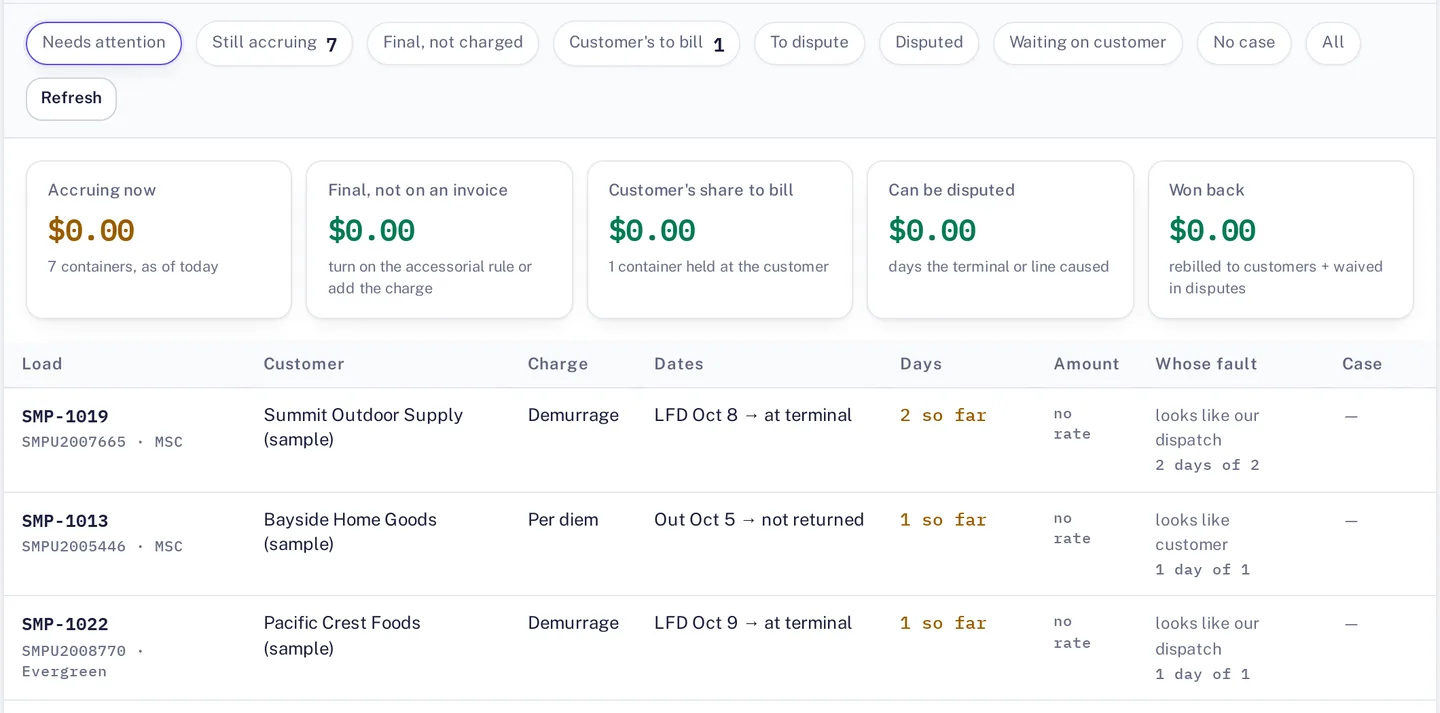
When a charge does land, Dispatch Board records per diem by day with a reason for each charged day: terminal closure, hold, container not available, later appointment or late customer delivery. One click bills the customer's share to the load, and a dispute letter to the line goes out with a packet of tracking events, appointments and closures. You record the answer (waived, partly waived or denied) and see what you won back. Try it free for 14 days on your own freight.
This guide is general information from the Dispatch Board team, not legal, tax or accounting advice. Rules and rates change: confirm against the official source linked in the text before you rely on them.
Keep reading
Guide
Three words for charges that sound alike but have different clocks and different billers. A worked example of one import container.
Guide
The date that decides whether a container costs you money. Where to find it, why it moves and how to plan pickups backwards from it.
Guide
Two ways to stop driving empty: what each needs, why lines say no and a worked mileage example with made-up numbers.
Product
Product
Start a 14-day trial and see per diem, last free day and dispute letters on your own freight.