Guide
What is per diem in drayage?
The daily equipment charge that quietly eats margin: how it starts, how days are counted, who pays and how to rebill or dispute it.
Guides / Dispatch
Two ways to stop driving empty: what each needs, why lines say no and a worked mileage example with made-up numbers.
Container drayage centers on reducing unpaid miles and terminal congestion. Traditional operations run import deliveries and export pickups as separate round trips. One driver delivers an import container and returns the empty box to the terminal. Another travels empty to collect an empty container, hauls it to an exporter, and returns the packed box. These four legs include two unpaid runs that waste fuel, chassis, and driver hours.
Two methods break this cycle: street turns and dual transactions.
A street turn reuses an empty import container directly for an export booking. Moving the box straight from warehouse to exporter eliminates both the empty return to the terminal and the empty dispatch for equipment.
A dual transaction optimizes gate visits. Instead of dropping an empty box and exiting bobtail, a driver completes two tasks in one visit, dropping an empty box and out-gating with an import load.
For carriers near container ports and rail ramps across Canada and the United States, these workflows protect operating margins, improve driver retention, and avoid per diem penalties.
Carriers cannot unilaterally redirect an empty import container to an export customer. Ocean lines own or lease equipment, and strict interchange contracts govern custody. Bypassing these rules triggers per diem fees, equipment penalties, and rejected containers at terminal gates.
Executing a compliant street turn requires six criteria:
Without authorization, the import interchange remains open and daily per diem continues to accrue.
While street turns bypass terminals, dual transactions tackle gate congestion directly. Gate queues, inspections, and crane delays consume driving hours. Visiting a terminal solely to drop an empty container wastes time queuing and exiting bobtail, only to repeat the cycle for an import pickup.
A dual transaction creates a balanced turnaround. A driver enters with an empty container or export load, drops it in the transfer zone, mounts an inbound import box, and exits with revenue freight.
This workflow delivers four benefits:
Dual transactions usually depend on the terminal's appointment system allowing a drop-off and a pickup in one visit, and the pickup must be free of holds. Rules vary by terminal, so check each one's current guidance before dispatch.
Dispatchers often identify clean equipment matches, only to have street turn requests rejected. Understanding why carriers deny approvals helps dispatchers anticipate equipment constraints.
The primary cause is global equipment imbalance. When a line faces container shortages overseas, its priority is evacuating empty boxes back to the terminal for vessel repositioning. Coordinators reject street turns and order empties returned directly to the terminal or an off-dock depot.
Empty return restrictions also block matchbacks. Lines issue directives dictating where specific equipment sizes must be returned for maintenance or leasing contracts. When a restriction is active, portals lock out street turns. Dispatchers should check daily return bulletins or depot notices to verify current return locations.
Export commodity requirements cause further rejections. Agricultural goods, specialty products, and food cargo demand strict container cleanliness. If an import container previously carried machinery or chemicals, lines disqualify the unit from sensitive export bookings.
Schedule mismatches also derail requests. If an export vessel is delayed or terminal intake has not opened, lines reject matchbacks to prevent equipment from sitting idle on private property or chassis.
Coordinating street turns and dual transactions requires balancing competing schedules: import demurrage and detention against export return dates and vessel cut-offs.
On the import side, the clock starts at discharge. Importers receive free days before terminal demurrage begins. Once outside the gate, per diem accrues until the empty container returns. Waiting for export matches risks daily charges. Because free time allowances and per diem rates vary by line tariffs and contracts, carriers should check current tariffs or booking terms for applicable rates and free time windows.
On the export side, two deadlines govern equipment movement:
A street turn transfers equipment custody from the import bill of lading to the export booking. Because transfer milestones vary across lines, dispatchers must check interchange terms in the line portal to confirm whether transfer occurs upon online approval or physical loading.
To protect against disputed charges, dispatchers must keep timestamped records of empty release times, inspection photos, portal approvals, and interchange receipts.
To evaluate trip savings, consider a practical comparison. This is a simplified, made-up illustration using invented round numbers to demonstrate operational mechanics and potential savings. These numbers are purely illustrative and do not represent specific carrier pricing, fuel costs, or terminal charges.
Consider a carrier near a port corridor with two jobs in one shift:
Handled as separate round trips, the work requires four legs: - Leg 1: Terminal to warehouse with loaded import (50 kilometers loaded). - Leg 2: Warehouse to port depot with empty container (50 kilometers empty). - Leg 3: Yard to terminal empty (40 kilometers), collecting an empty box and hauling to export plant (45 kilometers, totaling 85 kilometers empty hauling). - Leg 4: Export plant to terminal with loaded export (45 kilometers loaded), returning bobtail to yard (40 kilometers empty). This baseline totals 270 kilometers of travel, including 175 kilometers of non-revenue transit. Four gate visits at 60 minutes per entry consume 4 hours waiting at gates.
Coordinating an authorized street turn with a dual transaction alters the sequence: - Leg 1: Terminal to warehouse with loaded import (50 kilometers loaded). - Leg 2 (The Street Turn): Haul empty container from warehouse to export plant (10 kilometers empty). - Leg 3 (The Dual Transaction): Haul loaded export 45 kilometers to the terminal, drop it, and pick up an inbound import container before out-gating (45 kilometers loaded). This consolidated workflow totals 105 kilometers of travel, cutting distance by 165 kilometers compared to Scenario A. Non-revenue transit falls from 175 kilometers to 10 kilometers. Gate visits drop from four to two, cutting gate wait time from 4 hours to 2 hours while lowering fuel burn and equipment wear.
Achieving consistent trip pairings requires structured workflows and proactive equipment tracking. Successful dispatch teams treat matching as a daily discipline.
Effective matching starts with forward visibility. Dispatchers must track inbound manifests alongside export bookings before discharge. Waiting until a container sits empty leaves insufficient time to secure street turn approvals, dispatch drivers, and verify cargo availability. Review line portal submission windows and processing times to submit requests with adequate lead time.
To build a reliable matching routine, dispatchers should implement five practices:
Disciplined equipment tracking turns street turns and dual transactions into predictable daily routines.
A street turn reuses an empty import container directly for an export booking, bypassing the terminal. A dual transaction occurs at the terminal, dropping one container and picking up another in a single visit.
Per diem stays with the import shipment until the line approves the transfer. Once authorized, responsibility usually shifts to the export booking, but confirm how your line records it. Without approval, the carrier remains liable for detention.
No. Moving containers without authorization violates interchange contracts, leaves the import record open, and risks gate rejection. Always obtain portal approval before spotting the box.
The carrier absorbs the cost of hauling the rejected unit to a depot and collecting a replacement. Driver pre-trip inspections and interior photos prevent rejected containers.
Terminals that allow dual transactions usually let you book a drop-off and a pickup in one visit, and the pickup must be released. Rules vary by terminal, so check the terminal's current guidance.
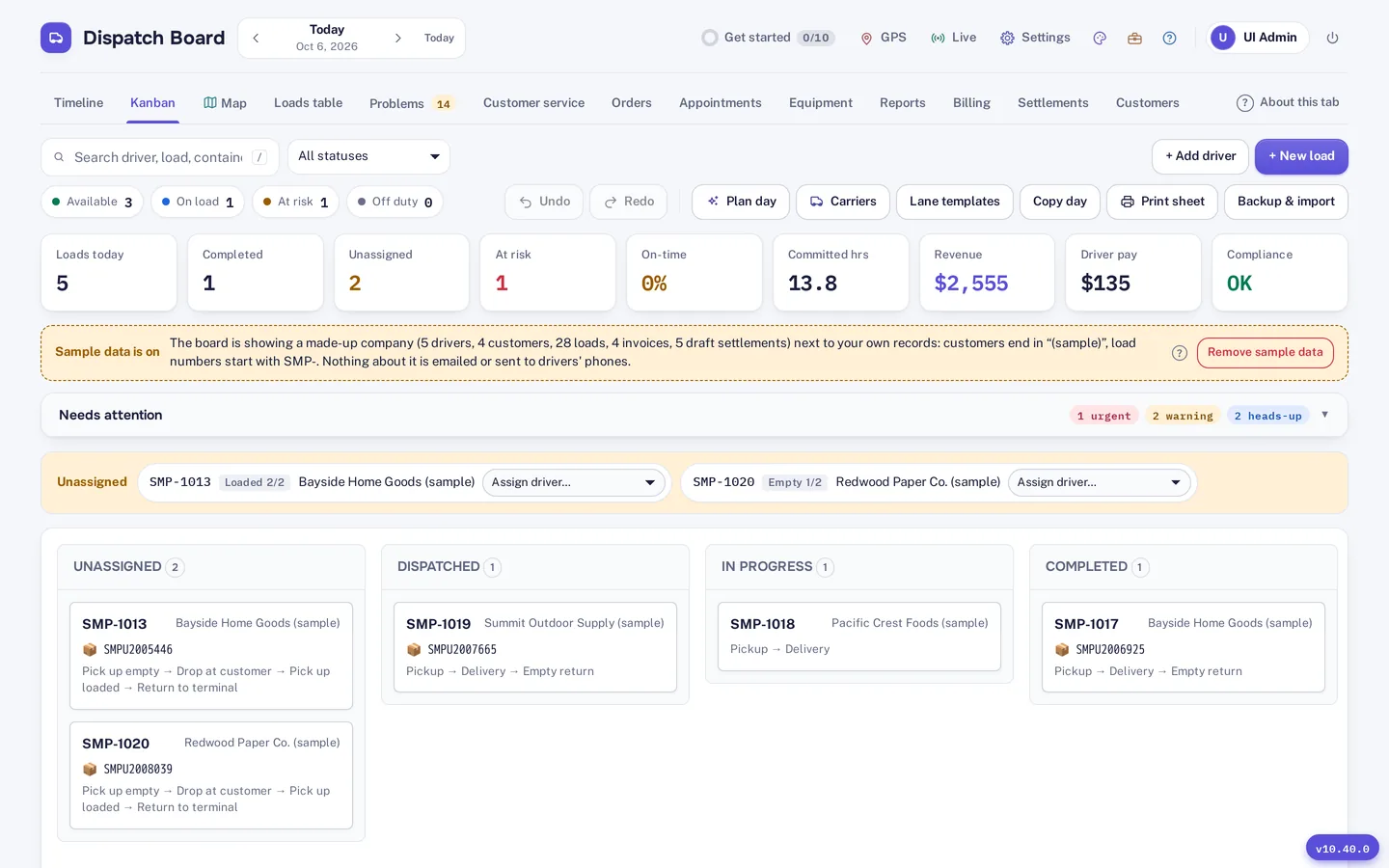
Dispatch Board suggests street turns and dual transactions from your own board, so a dispatcher sees a matching empty and export before a truck runs empty. It also shows empty return restrictions by place, line, size and dates, and the dual suggestions skip an empty the place will not take that day.
Container tracking through Terminal49 gives availability and last free day, per diem is recorded by day with a reason, and the driver app captures photos of the interior and signed documents. The line still has to approve a street turn. Dispatch Board does not book terminal appointments automatically. Try it free for 14 days.
This guide is general information from the Dispatch Board team, not legal, tax or accounting advice. Rules and rates change: confirm against the official source linked in the text before you rely on them.
Keep reading
Guide
The daily equipment charge that quietly eats margin: how it starts, how days are counted, who pays and how to rebill or dispute it.
Guide
The date that decides whether a container costs you money. Where to find it, why it moves and how to plan pickups backwards from it.
Guide
Base rates, fuel surcharge, accessorials and terms in a layout you can copy into a spreadsheet, with a worked quote.
Product
Product
Start a 14-day trial and see street turn and dual transaction suggestions on your board.