Guide
What is per diem in drayage?
The daily equipment charge that quietly eats margin: how it starts, how days are counted, who pays and how to rebill or dispute it.

Guides / Containers
The date that decides whether a container costs you money. Where to find it, why it moves and how to plan pickups backwards from it.
Last free day, abbreviated as LFD, is the final calendar date an import container can dwell at an ocean marine terminal or inland rail ramp without incurring storage fees. Facility operators provide this window to encourage yard velocity and rapid equipment turnover. Once that window expires, the container enters storage penalty status, commonly termed demurrage.
For drayage carriers, tracking the last free day is an essential priority. Free time does not start when a vessel berths or a train arrives. At marine terminals, it generally begins only after the container is discharged, grounded, cleared of carrier holds, and posted as available in the terminal operating system. At inland rail ramps, it starts after de-ramping and official ramp notification.
Free time allowances vary across terminal tariffs, rail guides, carrier contracts, and equipment types. Free time can differ by equipment type, for example for refrigerated or hazardous cargo. Because policies vary, carriers must check the current rule published by the specific terminal or rail operator.
Missing a deadline triggers immediate disruption. Terminals can block release until charges are paid. Carriers risk paying storage fees out of pocket while pursuing reimbursement from cargo owners.
A preliminary arrival notice from the line is only an estimate. The date that counts is the one in the terminal or rail ramp system where the container sits, so look up each container number in that portal and confirm it is available. Container tracking tools gather these feeds in one place and alert you when a date changes.
The last free day can shift after the first notice, for example when a vessel is late, a rail ramp is delayed, a gate closes for weather or a hold is released late. Keep checking until the container is out.
A frequent misunderstanding in import drayage is the confusion between terminal demurrage and ocean carrier per diem. While both charges penalize freight delays, they apply to completely different assets, are billed by different entities, and operate on separate clocks.
Terminal demurrage is a real estate storage fee charged by the marine terminal operator or railway. It compensates the facility for physical yard space occupied by a loaded container that has outstayed its free time. Demurrage accumulates daily from the moment the last free day expires until the container exits the terminal gate. Because terminals have limited acreage, demurrage fees are structured on escalating tiers where daily charges increase the longer a container sits.
Ocean carrier per diem, often referred to as equipment detention, is an equipment rental penalty charged by the shipping line or container owner. It compensates the carrier for detaining its physical container and chassis outside terminal gates. The per diem clock typically begins the moment the driver gates out with the loaded container. The shipping line provides a specified allowance of equipment free days for the trucker to deliver the box, wait for unloading, and return the empty container to an authorized depot.
Even when an import container is grounded and nominal free time is running, drayage carriers may be unable to retrieve it due to administrative or regulatory holds. A container blocked by a hold cannot be gated out, yet at many facilities the storage clock does not automatically pause while the hold remains in place.
Government inspection holds are a common barrier: customs and other agencies can hold a container for document review or an exam before the terminal releases it.
Holds can also come from commercial causes: unpaid ocean freight, a customs broker entry that has not cleared, unpaid terminal fees, or a safety issue with the equipment.
Dispatchers must distinguish between electronic system clearance and physical availability. A container may show released in the operating system while physically buried inside an inaccessible closed stack. Conversely, a container may be physically accessible but blocked at the gate because an electronic agency hold has not synchronized.
When a hold prevents pickup before the last free day, dispatchers must immediately document the restriction with date-stamped portal screenshots. Facilities vary on whether an administrative hold pauses the demurrage clock. Dispatchers must check the current rule in the governing terminal tariff to confirm whether an active hold stops demurrage accrual.
Tariffs define whether free time counts working days or calendar days, and many switch to calendar days once demurrage starts, so weekends can bill even when the gate is shut. Gate hours and holidays differ by terminal, and an unplanned closure can land on your last free day. If the gate is closed on that day, check the tariff for whether the deadline rolls to the next business day.

Effective drayage dispatching requires working backwards from the last free day rather than planning forwards from the vessel arrival date. A backward scheduling workflow ensures that delivery appointments, terminal gate slots, and chassis equipment align before storage penalties begin.
The planning process begins with the delivery destination. Confirm when the consignee can actually receive the container, because many warehouses need an appointment.
The second variable is terminal appointment availability. Most major container terminals require motor carriers to reserve gate slots in advance through appointment systems. In busy ports, appointment slots can book out several days ahead. Dispatchers who wait until the morning of the last free day often find that all slots are exhausted, making on-time pickup impossible.
Chassis availability is the third dependency. If you need a chassis from a pool yard first, allow for the extra trip and gate time.
When customer facilities cannot receive freight before the deadline, carriers often perform an import pre-pull. The driver retrieves the loaded box before the last free day to stop terminal demurrage, staging it in the carrier private yard until delivery. While this halts terminal storage charges, it starts the ocean carrier per diem clock, consumes a road chassis, and introduces local yard storage and lift fees.
Despite careful planning, situations arise where retrieving an import container before its last free day becomes impossible. Severe yard congestion, unexpected customs holds, terminal appointment shortages, or customer warehouse shutdowns can disrupt the dispatch schedule. When missing a deadline is unavoidable, taking prompt administrative action minimizes financial loss and prevents disputes:
To illustrate how storage costs compound and how a carrier manages the dispute process, consider the following worked scenario. This scenario is a completely made-up illustration using invented round numbers to demonstrate the calculations and administrative steps.
Assume a drayage carrier is hired to move an import container discharged at a marine terminal. The terminal tariff allows three days of free storage following discharge, setting the last free day as Thursday. The terminal tariff specifies an illustrative demurrage rate of $150 per day ( these rates are purely illustrative round numbers; always check the current rule in the specific terminal tariff). On Wednesday morning, the dispatcher attempts to schedule a pickup for Thursday. However, the terminal operating portal displays an active commercial hold placed by the shipping line due to an uncollected destination administrative fee. The dispatcher immediately alerts the freight forwarder by email at 9:00 AM on Wednesday. The shipping line lifts the commercial hold on Thursday afternoon at 3:30 PM, shortly before the reservation window closes. The dispatcher immediately accesses the terminal appointment system at 3:45 PM to reserve a Friday gate slot, but the system indicates that all Friday appointment slots are fully booked. The terminal gate is closed for import pickups on Saturday and Sunday. The earliest available appointment slot is Monday morning at 8:00 AM. Because the container was not gated out by Thursday close of business, demurrage begins accumulating on Friday morning: - Friday: Day 1 past the last free day, charged at the illustrative rate of $150. - Saturday: Day 2 past the last free day, charged at the illustrative rate of $150 (terminal closed, but calendar day demurrage applies under the illustrative tariff). - Sunday: Day 3 past the last free day, charged at the illustrative rate of $150 (terminal closed, calendar day demurrage applies). - Total demurrage payable at the terminal gate Monday morning: $450 (illustrative total). The ocean carrier allows four equipment free days under its bill of lading tariff before per diem charges begin. The driver retrieves the container Monday at 8:30 AM, delivers it to the customer warehouse Monday afternoon, the container is unloaded Tuesday, and the driver returns the empty box to an authorized depot Wednesday morning. Total equipment time used is three days (Monday through Wednesday), which falls within the four-day equipment free time window. Consequently, ocean carrier per diem is $0. The carrier pays the $450 to release the box, then keeps the evidence together: portal screenshots of the hold, the sold-out Friday slots and the weekend closure notice. It asks the terminal for a waiver, and bills the $450 to the customer as a pass-through, with a credit if the waiver is granted.
Yes. If conditions change, such as a gate closure, equipment problem or a container placed in an inaccessible stack, the posted date can move. Check the terminal portal daily until the container is out.
Not automatically at every facility. Some terminals extend free time or waive charges when a government exam holds the box, and others keep counting. Read the terminal or rail tariff and keep a dated screenshot of the hold.
Under a bill of lading the cargo owner is usually responsible, but the trucker often pays at the gate to get the box out. If slots were unavailable through no fault of yours, ask for a waiver with screenshots, and if it is refused, bill the cost to the customer with the evidence.
Collecting the container before the last free day and holding it in your yard until the customer can receive it. It stops terminal demurrage, but it can start the line's per diem and adds yard and handling cost, so price it as an accessorial.
It depends on the tariff. Some count working days only during free time and calendar days after it, and others count calendar days throughout. Check how the specific terminal or ramp counts, and do not assume.
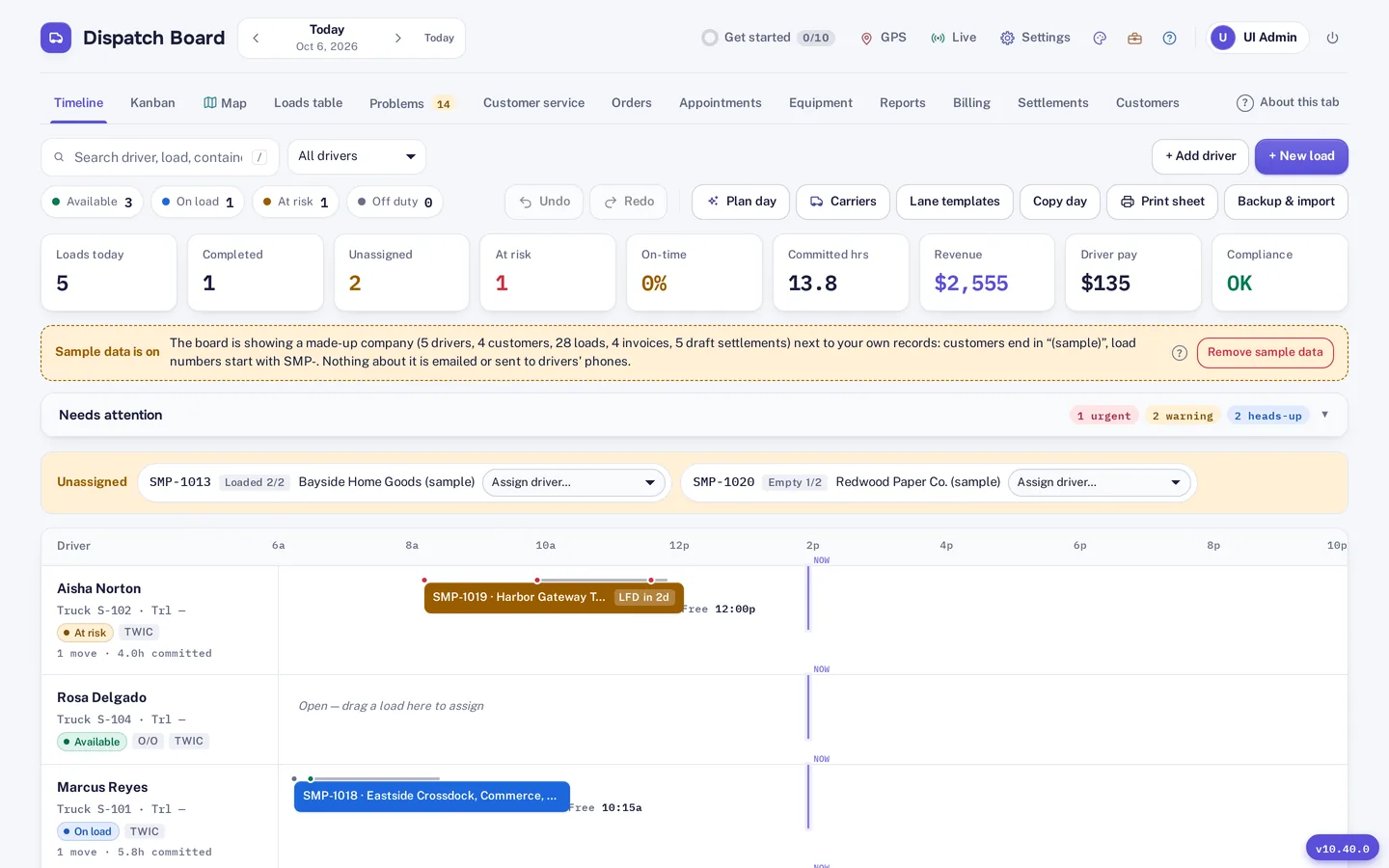
Dispatch Board's container tracking through Terminal49 shows availability and last free day on each load, with vessel arrival alerts, and the Problems tab flags holds, last free days and late moves. Plan day avoids a shut gate and lets you pin rows, and hold alerts warn you before a driver is sent.
If a charge is unavoidable, per diem is recorded by day with the reason, a dispute letter to the line goes out with a packet of tracking events, appointments and closures, and the customer's share is billed in one click. Customers can follow a load with a public tracking link instead of calling. Try it free for 14 days.
This guide is general information from the Dispatch Board team, not legal, tax or accounting advice. Rules and rates change: confirm against the official source linked in the text before you rely on them.
Keep reading
Guide
The daily equipment charge that quietly eats margin: how it starts, how days are counted, who pays and how to rebill or dispute it.
Guide
Three words for charges that sound alike but have different clocks and different billers. A worked example of one import container.
Guide
Two ways to stop driving empty: what each needs, why lines say no and a worked mileage example with made-up numbers.
Product
Product
Start a 14-day trial and track availability and last free day through Terminal49.