Guide
BC Container Trucking Act and driver pay rates.
Who needs a CTS licence, how the rate order is structured and a period-by-period pay check, with links to the official OBCCTC pages.

Guides / Compliance
Who needs an IFTA licence, what goes in the quarterly return and how drayage idling and short moves create audit risk.
The International Fuel Tax Agreement (IFTA) simplifies fuel tax reporting for commercial carriers operating across 48 US states and 10 Canadian provinces. Rather than securing separate licences and filing returns in each jurisdiction traveled, carriers report quarterly to their home base jurisdiction.
For Canadian carriers, IFTA is administered by provincial authorities (such as the British Columbia Ministry of Finance, Ontario Ministry of Finance, or Revenu Quebec). Your base province issues credentials, processes returns, audits records, and distributes net settlements.
In container drayage, operations center on intermodal hubs: marine terminals, rail ramps, off-dock yards, and transload warehouses. Fleets that stay entirely inside their home province generally settle fuel taxes at the pump and do not need an IFTA licence.
When qualified tractors cross borders, multi-jurisdictional rules apply. Fuel tax is owed where fuel is consumed rather than where purchased. Because tractors burn fuel on highways, in queues, and at customer docks, carriers must reconcile fuel purchases against distance traveled in each jurisdiction.
Disclaimer: This article provides general industry information for educational purposes and does not constitute legal, accounting, or tax advice. Rules and rates vary by jurisdiction. Always verify current requirements with your base licensing authority or a qualified transportation tax advisor.
Not every commercial vehicle falls under IFTA. The agreement sets physical criteria to determine which vehicles report fuel taxes. Carriers can review official definitions at IFTA, Inc. and confirm rules with their base jurisdiction. Generally, a qualified motor vehicle includes any property-carrying vehicle that:
In container cartage, standard road tractors qualify immediately. Tandem-axle day cabs and highway tractors pulling chassis loaded with 20-foot, 40-foot, or 53-foot containers exceed both axle and weight thresholds. Two-axle tractors paired with tandem chassis combinations also qualify.
Operational geography dictates compliance. Fleets hauling containers strictly between local terminals, rail ramps, and warehouses within their home province do not need IFTA credentials; pump taxes satisfy local obligations.
When your trucks cross borders, an IFTA licence with decals lets you report all your fuel tax in one return to your base jurisdiction. Ask your base jurisdiction how to apply and what it costs.
IFTA compliance depends on verifiable documentation. In an audit, your base licensing authority examines two primary records: total distance traveled by jurisdiction and total tax-paid fuel purchased in each jurisdiction.
Distance tracking requires an unbroken audit trail for every qualified vehicle. Drayage carriers rely on Electronic Logging Devices (ELDs) and telematics that log GPS coordinates, time stamps, and odometer readings. Compliant records must document:
Drayage presents tracking challenges because tractors regularly perform non-revenue moves: bobtailing, repositioning chassis to off-dock depots, gate moves, and yard shuffles. Auditors require complete odometer continuity. Unexplained distance gaps, including personal conveyance and road tests, trigger audit penalties.
Fuel records require equal rigor. Claiming tax-paid credits requires receipts or fuel card reports showing dates, vendor details, fuel volumes (liters or gallons), clear diesel grade, prices, vehicle numbers, and purchaser names. Bulk tanks require delivery invoices, dip logs, and separate dispensing records for non-IFTA equipment.
Standard IFTA guidelines require retaining records for four years from the filing date, but retention schedules can vary under provincial, state, or corporate statutes. Check current retention rules with your base licensing authority.

IFTA returns are filed quarterly to reconcile fleet distance against tax-paid fuel purchases across member jurisdictions. Reporting covers standard calendar quarters: Q1 (January through March), Q2 (April through June), Q3 (July through September), and Q4 (October through December).
Returns are due by the last day of the month after the quarter ends (30 April, 31 July, 31 October and 31 January), moving to the next business day when that falls on a weekend or holiday. Filing portals and payment methods differ by province, so confirm the schedule with your base jurisdiction.
Carriers must observe zero-activity reporting. If you hold an active licence, you must file even if your fleet was inactive or operated exclusively within your home province. Failing to file can bring penalties, interest, estimated assessments and a suspended licence. Check penalty rules with your base jurisdiction.
The quarterly calculation follows a standardized sequence:
The following hypothetical scenario illustrates IFTA calculation mechanics.
This example uses simplified, rounded figures for illustration. Fuel tax rates change, and exchange rates fluctuate. Verify current tax rates and procedures with your base jurisdiction or official IFTA matrices before filing.
Consider a British Columbia drayage carrier operating two tandem-axle day cabs hauling containers between coastal terminals in British Columbia and customer facilities in Washington state.
Quarterly travel and fuel records (in miles and US gallons):
Step 1: Fleet fuel economy. 20,000 miles / 4,000 gallons = 5.0 MPG.
Step 2: Taxable fuel consumed.
Step 3: Net taxable fuel position.
Step 4: Illustrative quarterly tax rates.
Step 5: Jurisdictional tax calculations.
Step 6: Net settlement. $240.00 credit minus $200.00 liability = $40.00 net refund credit.
Because the carrier bought surplus tax-paid fuel in British Columbia relative to distance driven there, the credit offsets liability owed to Washington. The base province issues the $40.00 refund credit and handles inter-jurisdictional settlement.
Drayage carriers face operational conditions that attract audit scrutiny. Understanding these risks helps fleets protect their compliance standing.
Extended terminal queue time is the most prevalent risk. Tractors spend hours idling outside gates, in inspection lanes, or awaiting container lifts. This stationary burn reduces fleet average fuel economy. If distance records contain gaps, auditors may assign a default fuel economy rate, inflating taxable consumption and generating assessments with interest. Check audit rules with your base jurisdiction.
Unrecorded short-haul movements create another trap. Routine moves (bobtailing, repositioning chassis to off-dock depots, gate moves, and road tests) often go unlogged. If drivers omit readings or telematics drop signals, odometer continuity breaks. In an audit, unexplained distance gaps can lead to assessments.
Incomplete fuel receipts also trigger penalties. Receipts missing vehicle unit numbers, vendor addresses, legible print, or fuel volumes are disallowed, erasing tax credits while traveled distance remains taxable. Bulk fuel from a yard tank can lose its tax credit if it is not properly metered and documented.
Relying on a rushed effort at quarter end invites errors and penalties. Sustainable compliance requires structured habits within daily dispatch workflows.
Centralize fuel purchasing through commercial fuel cards. Fuel cards automatically record transaction dates, vendor locations, volumes, prices, driver IDs, and vehicle numbers at the pump, eliminating lost or illegible receipts.
Establish a monthly reconciliation workflow:
For carriers using owner-operators, lease agreements must detail IFTA obligations: whether contractors operate under company credentials, how taxes settle on pay statements, and rules for submitting receipts.
Finally, maintain consistency across operational records. Auditors compare IFTA filings against maintenance invoices, inspection reports, and trip logs. Conflicting odometer readings trigger expanded audits. Aligned records protect your fleet.
Generally not. Carriers operating qualified vehicles exclusively within their home province do not need an IFTA licence. When moves remain within provincial borders, pump fuel taxes fulfill all obligations. IFTA matters when trucks cross into other member jurisdictions, such as other provinces or US states. Confirm with your base jurisdiction.
IFTA in Canada is administered by provincial governments, not the Canada Revenue Agency. You obtain credentials and file returns with your home province authority (such as the British Columbia Ministry of Finance, Ontario Ministry of Finance, or Revenu Quebec), which coordinates settlements with other jurisdictions.
You must still file a quarterly return reporting zero cross-border distance. Holding an active licence requires filing every quarter until cancelled. Failing to file can bring penalties, estimated assessments and a suspended licence. Check penalty rules with your base jurisdiction.
Extended idling at terminals, rail ramps, and customer facilities burns fuel while stationary, lowering fleet average fuel economy. Because IFTA divides jurisdictional distance by this average, lower fuel economy raises the taxable fuel calculated for each jurisdiction. Telematics records substantiate figures during an audit.
Standard IFTA guidelines require retaining trip logs, telematics records, fuel receipts, bulk fuel logs, and returns for four years from filing. Because retention rules vary under provincial, state, or corporate statutes, confirm exact timelines with your base licensing authority.
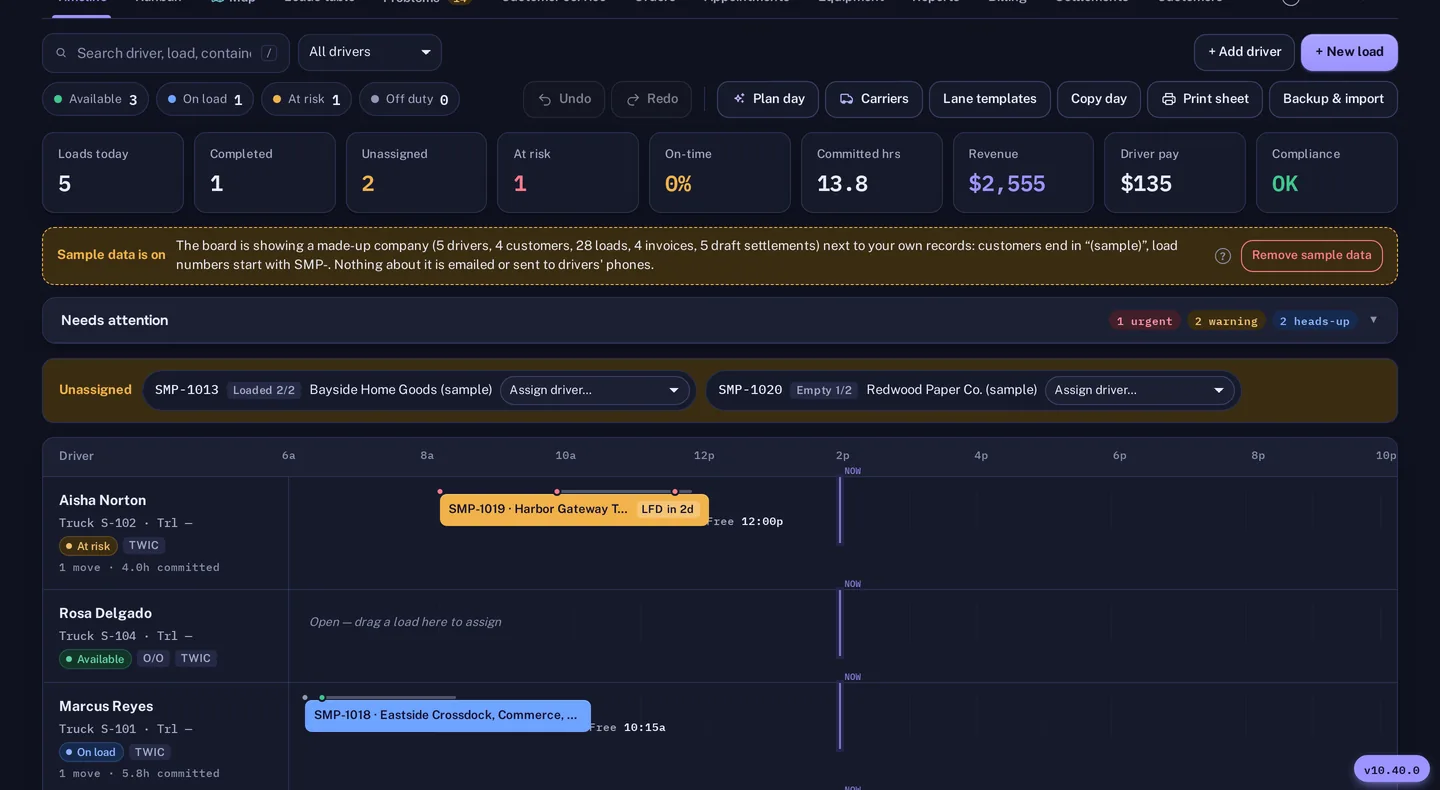
Dispatch Board produces IFTA reports and imports fuel card data, so the numbers for your quarterly return come from the same place as your loads and trucks. Maintenance schedules, DVIR inspections and a compliance calendar for expiries sit alongside, and GPS from Samsara, Motive or One Step GPS can feed the truck positions.
It does not file the return for you: you still file with your base jurisdiction, and you should check the current rates and rules there. Try it free for 14 days.
This guide is general information from the Dispatch Board team, not legal, tax or accounting advice. Rules and rates change: confirm against the official source linked in the text before you rely on them.
Keep reading
Guide
Who needs a CTS licence, how the rate order is structured and a period-by-period pay check, with links to the official OBCCTC pages.
Guide
A walk-around checklist for the tractor, the chassis and the container, plus how to handle the gate and what to do about defects.
Guide
Eight steps from business number to first invoice, with pointers to where each current rule is published and the mistakes new carriers repeat.
Product
Product
Start a 14-day trial and produce IFTA reports from your own trucks and fuel cards.